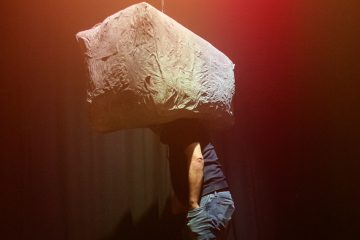
From February 1st to March 31st, Hannie is staying at Fundazium Nairs to work on a new film project: “When the Mountain Looks Back: A Film About Rocky Perception”.
She will travel to the Swiss Alps to encounter the mountain landscape and engage in conversation with this entity.
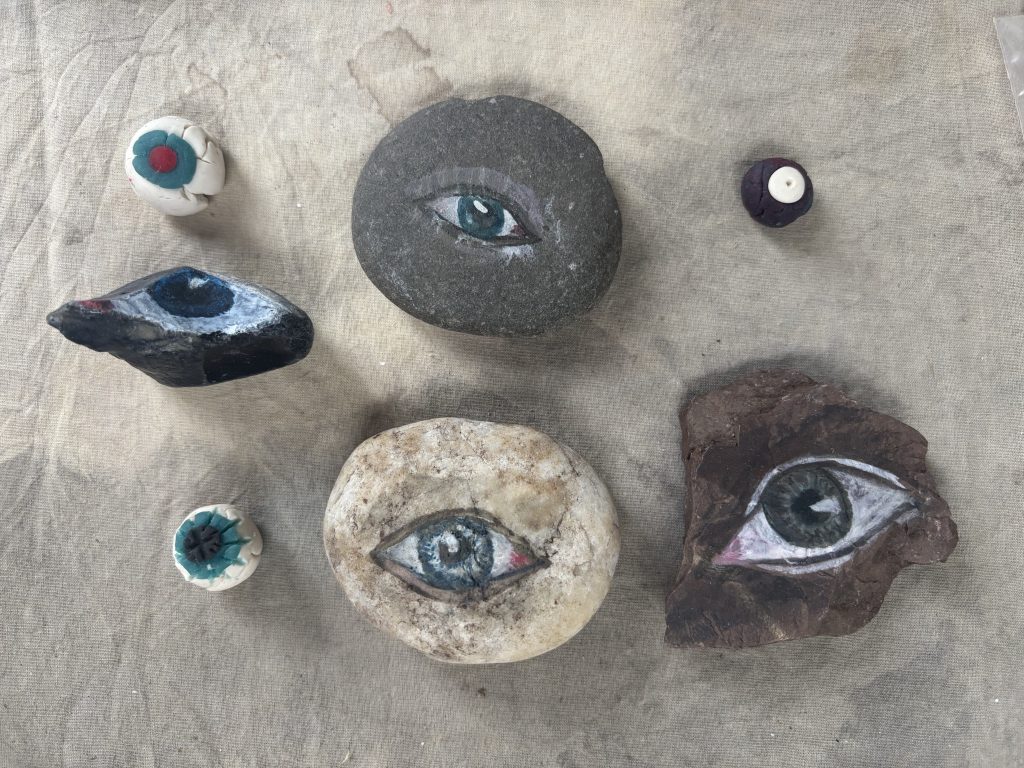
By spending two months in the Swiss mountains, she wants to explore the following questions: How are the eyes of the mountain constructed? How does the mountain perceive? How does the mountain react to what it sees? Furthermore, I want to ask: How can I capture and communicate this “looking” with the camera’s eye? How can I learn to see with the eyes of the mountain?
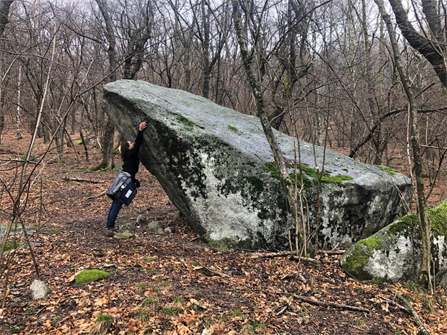
She will hike, observe, draw, and write about the seemingly inert presence of the mountain, to return with a film plan in my backpack.
With thanks to the Stichting Gerbrandy Cultuurfonds for the financial support.
Follow me on my Instagram account: @hannievandenbergh
Mountains and remote, layered landscapes have become central to her current research.
During her travels to the mountains of Finland, Japan, Scotland and Italy she experienced a deep connection between the landscape and her. She experienced how she has to relate to a much older and more resilient entity. These experiences led to her new project When the Land Looks Back: Towards a Film Installation on Landscape and Perception This research project sets out to explore the reciprocal relationship between humans and landscape through a multidisciplinary process involving walking, drawing, writing, and collecting. Central to the project is a reflection on how landscape is not only observed and interpreted by us, but how it may, metaphorically or sensorially, “look back” at us. Two texts will guide the theoretical and poetic framework of this research: The Living Mountain by Nan Shepherd and Turning to Stone: Discovering the Subtle Wisdom of Rocks by Marcia Bjornerud. While Shepherd approaches the mountain not as a distant object but as a living presence to be entered and felt, Bjornerud unveils the deep time of geology and the eloquence of stone. Both writers challenge dominant modes of human-centered perception and offer instead an attunement to the temporal, material, and affective dimensions of landscape.
Drawing from their work and her experiences, she intends to explore how landscape holds memory, how it shapes and is shaped by human presence, and how it might offer a gaze of its own—silent but watchful. This investigation will not be purely intellectual or illustrative, but deeply embedded in embodied practice. Walking will be central: as a way of thinking, noticing, and being-with. Through walking, she will engage in a slow and responsive method of site-based research, recording impressions, sounds, and gestures of the land.
What begins as a “looking at” gradually evolves into an encounter about mutual perception. The mountain sees the hiker approaching and departing. What happens in this encounter? Who is looking and who is being looked at? By learning to see through the “eye” of the mountain, Hannie explores her own vision impairment and how to cope with it; how her diminishing vision relates to the life force and vitality of the mountain.
She will keep a field notebook of writings, drawings, and collected materials, which will serve both as research documentation and as the early script of a new film work. These fragments—visual, textual, and sonic—will form the groundwork for a film (installation) in which the idea of “the land looking back” is rendered sensorially and emotionally.